
UHF Integrated RFID Reader
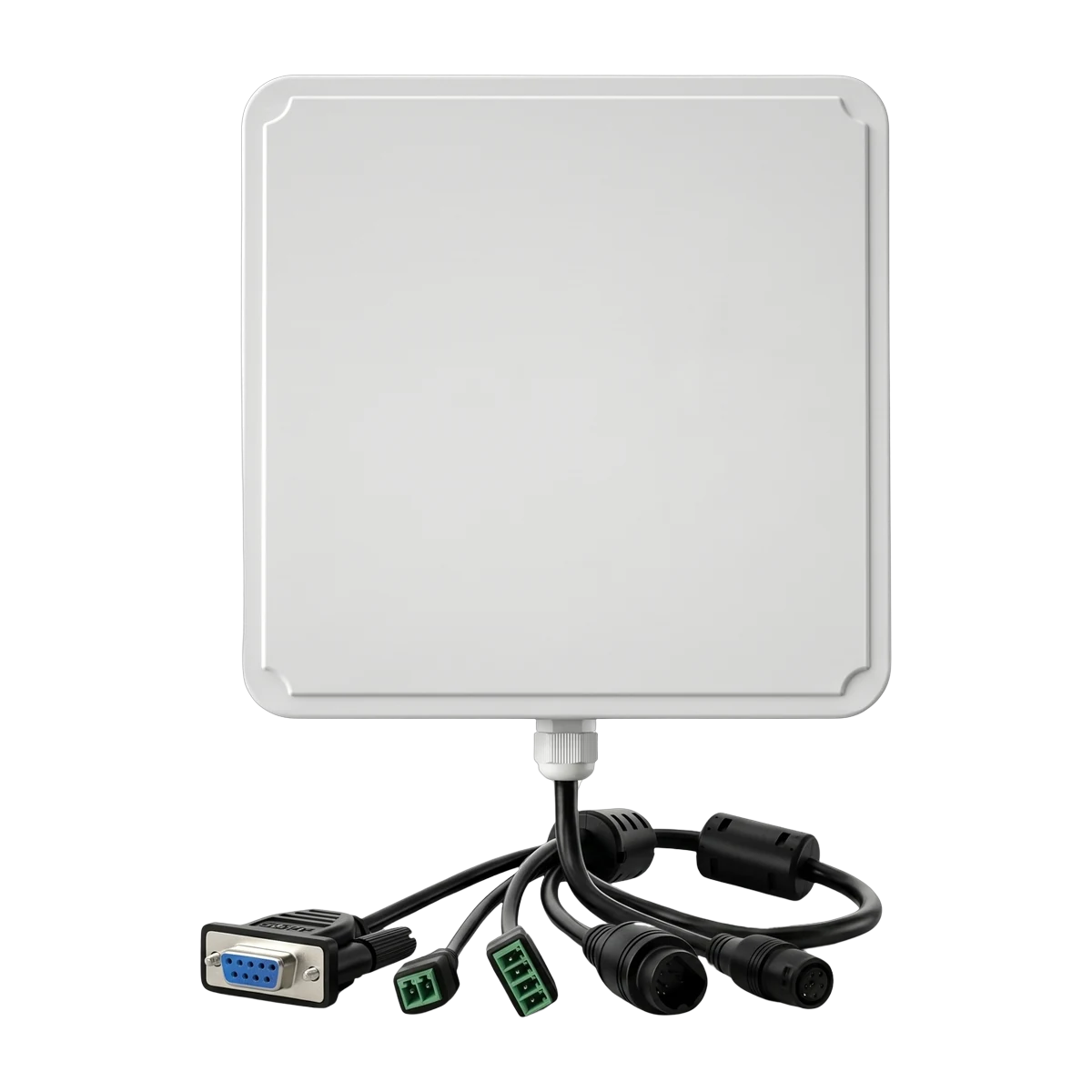
RLI-9dBi Integrated UHF RFID Reader
Automate long-range tag capture at vehicle lanes, logistics gates and industrial checkpoints with a built-in 9 dBi circularly polarized antenna, adjustable RF power and industrial I/O.
Reduce repeated manual identification, process multiple RFID events at a fixed read point and return an immediate validation or control response to the connected system.
*The product data sheet states a typical continuous read range of up to 15 m. Actual UHF RFID performance depends on the tag, mounting material, orientation, lane geometry, reader placement, regional RF settings, output power and site environment.
Operational Value
From Repetitive Manual Checks to Automated RFID Confirmation
The RLI-9dBi is designed for recurring vehicle, logistics and industrial checkpoints where the same identify, validate and respond sequence would otherwise require repeated operator checks.
Manual Identification Checkpoint
Repeated action for every vehicle, shipment or tagged asset

More repeated interaction, slower confirmation and more opportunities for delayed or incomplete checkpoint records.
Automated RFID Checkpoint
Repeatable trigger, read and response sequence
Operational improvements depend on the complete deployment, including tag selection, read-zone validation, host software, process rules and user adoption. Quantified time, accuracy or labor savings should be published only when supported by project data.
Good Reasons
Why Choose the RLI-9dBi Integrated RFID Reader?
Four product-level reasons help system integrators determine whether this long-range integrated RFID reader matches the required lane, gate, tag population and control workflow.
Integrated 9 dBi Circular Antenna
The UHF RFID reader engine and 9 dBi circularly polarized antenna are combined in one fixed unit for directional, long-range identification.
Up to 15 m Typical Read Range
Long-range coverage supports vehicle lanes, container gates and logistics transfer points when the actual tag, mounting and site conditions are validated.
High-Volume Tag Processing
Read performance of up to 400 reads per second and a stated multi-tag capacity of 600 tags in 3 seconds support busy fixed checkpoints under suitable conditions.
Industrial I/O and Flexible Connectivity
RS-232, two opto-isolated inputs and two relay outputs are supported, with Wiegand, Ethernet and wireless options available by configuration.
RFID Event Workflow
Turn Each Tag Read into an Immediate Process Response
The RLI-9dBi can sit inside a vehicle, container, logistics or industrial workflow: receive a trigger, capture tag data, pass the event to the host and return an immediate response to the field.
Start a read cycle from a loop detector, photoelectric sensor, PLC or another compatible control signal through either optocoupler input.
Send EPC, TID or user-memory data to the connected application for vehicle identification, access authorization, shipment tracking or process verification.
Use either relay output to activate a compatible light, buzzer, gate signal or other checkpoint response defined by the integration.
Applications
Long-Range RFID Applications for Lanes, Gates and Transfer Points
The RLI-9dBi is strongest where vehicles, containers, pallets or tagged assets follow a defined approach path and the reader position, trigger window and response logic can be validated.
 Vehicle Management
Vehicle and Yard Identification Lane
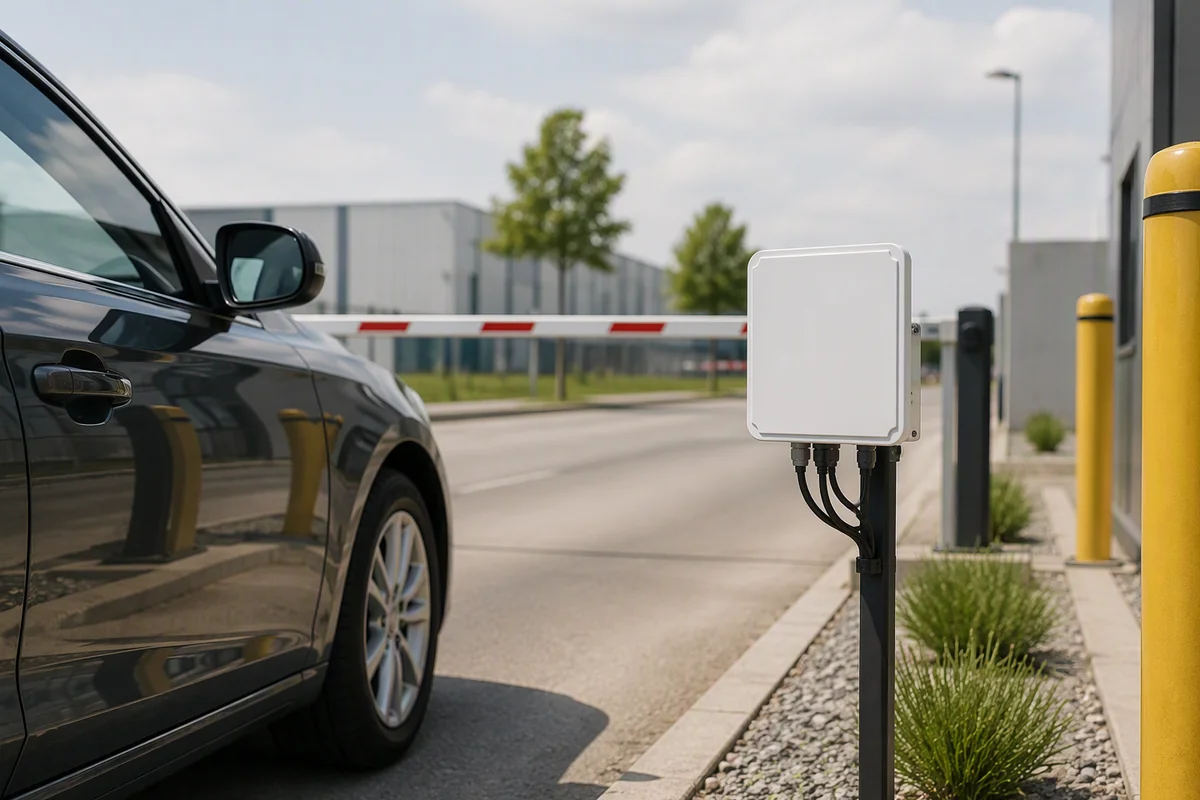
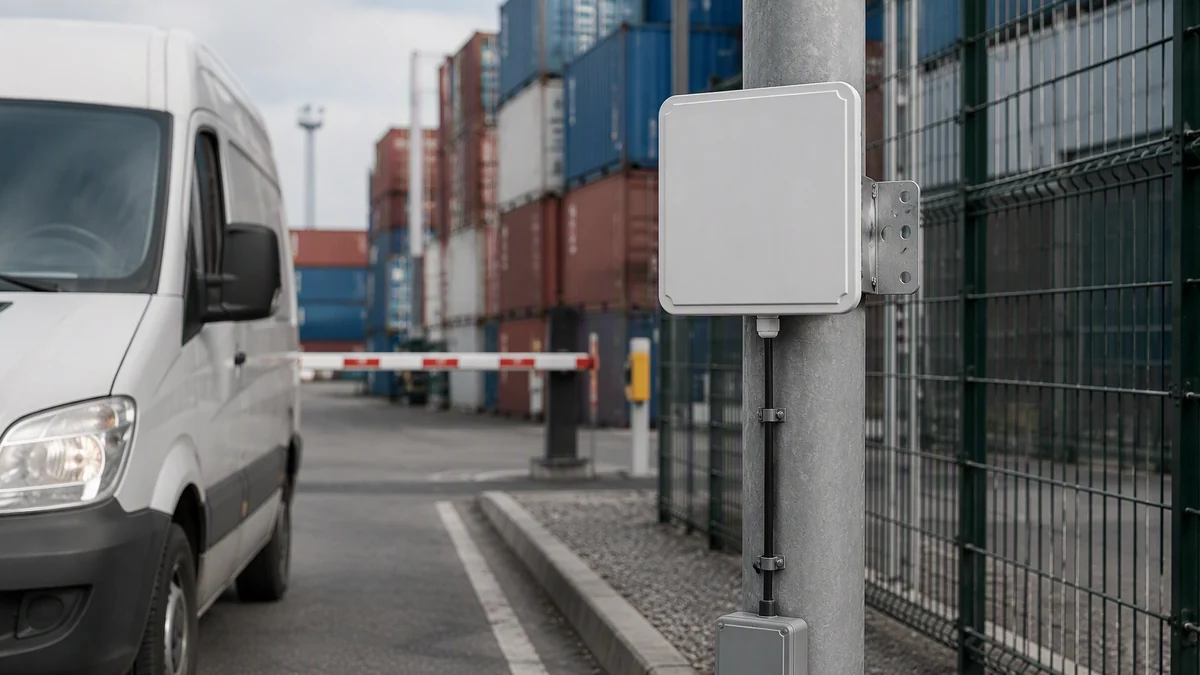
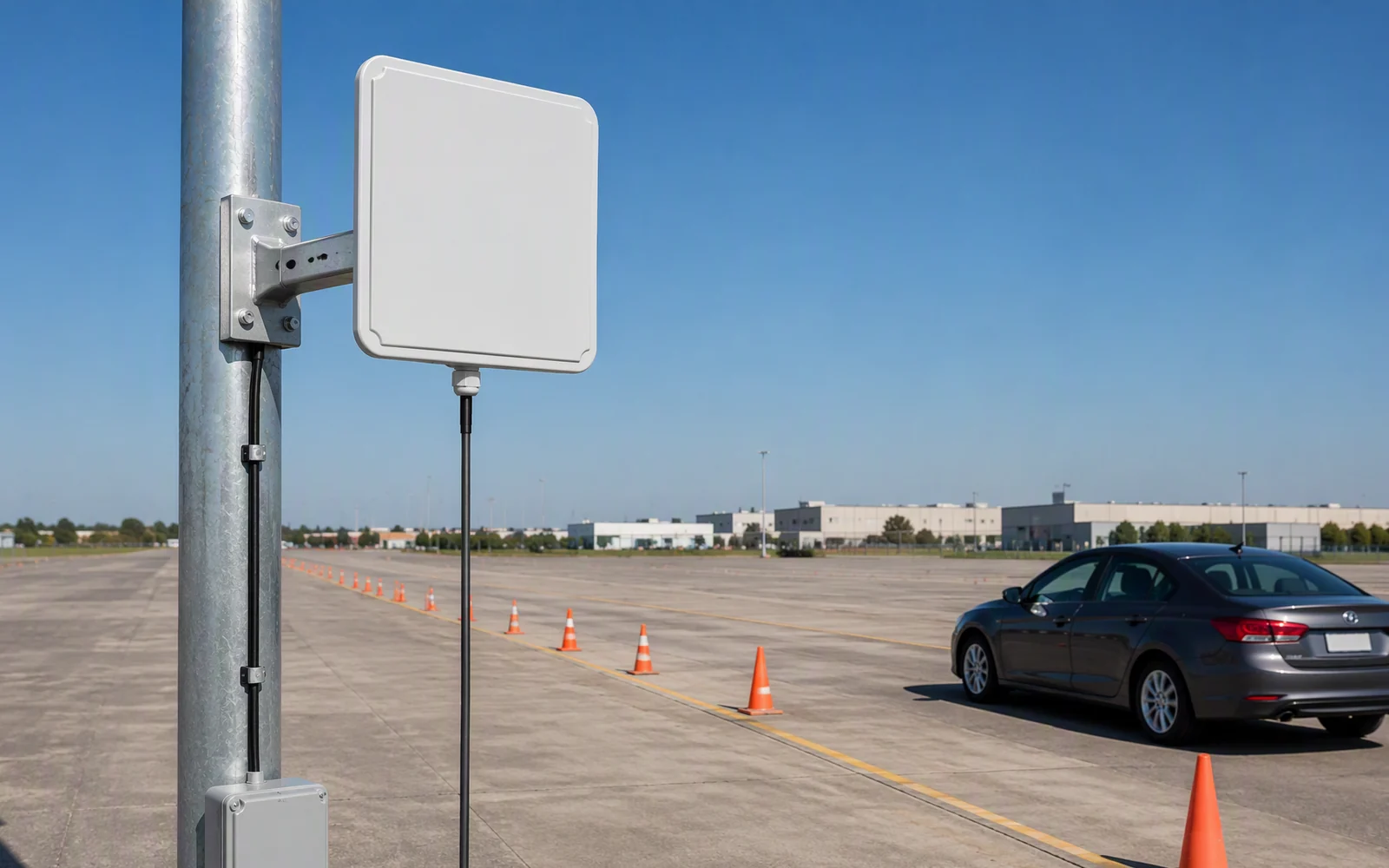
Identify tagged vehicles at parking, yard, customs, fleet or controlled-entry lanes and return the event to the connected access or vehicle-management system.
- Defined vehicle approach direction
- Host-side authorization or status check
- Relay or gate response after validation
 Logistics
Container and Logistics Gate
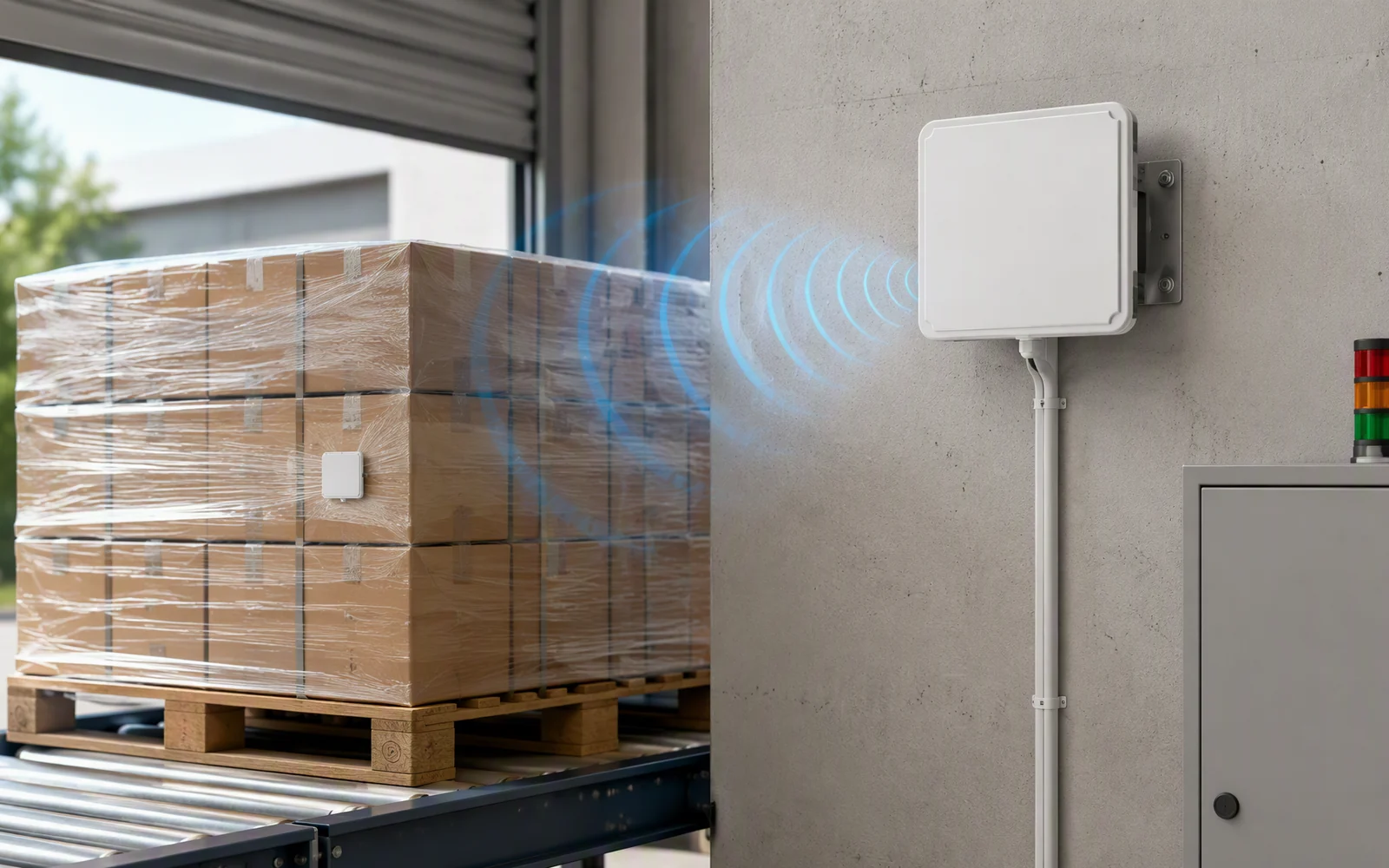
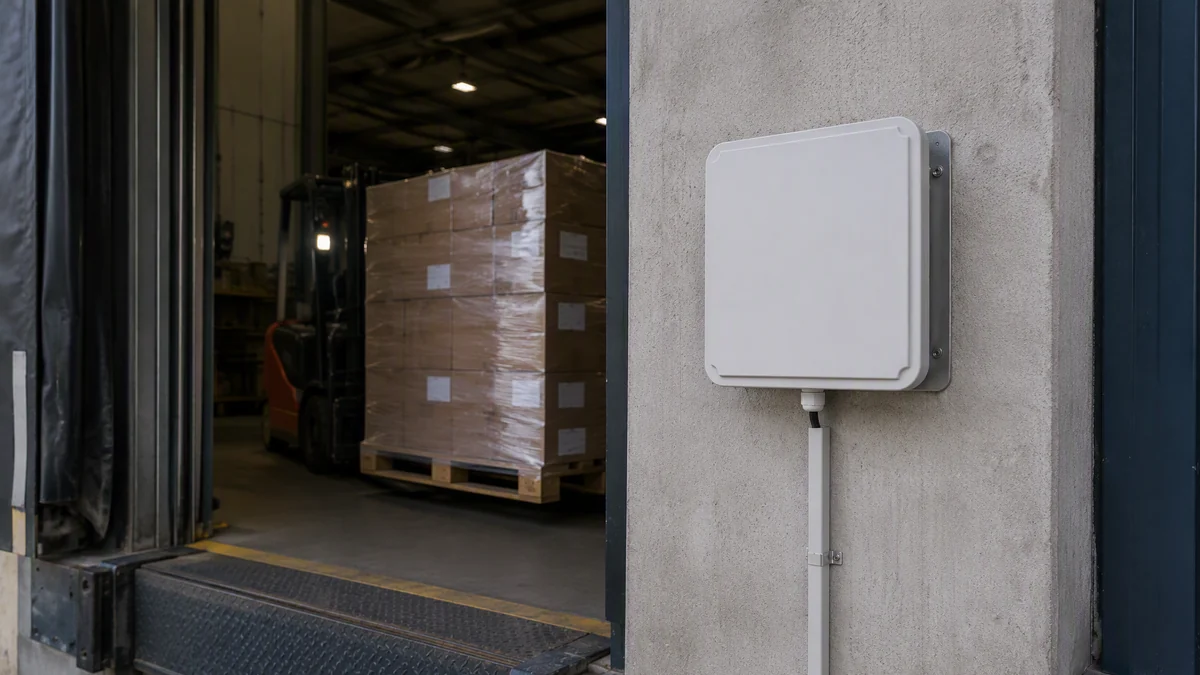
Capture tagged containers, pallets, bins or cargo as they pass warehouse entrances, loading areas, transfer gates or container-operation checkpoints.
- Longer fixed approach path
- Automatic arrival or transfer record
- WMS, middleware or local host connection
 Industrial Automation
Production Transfer and Process Control
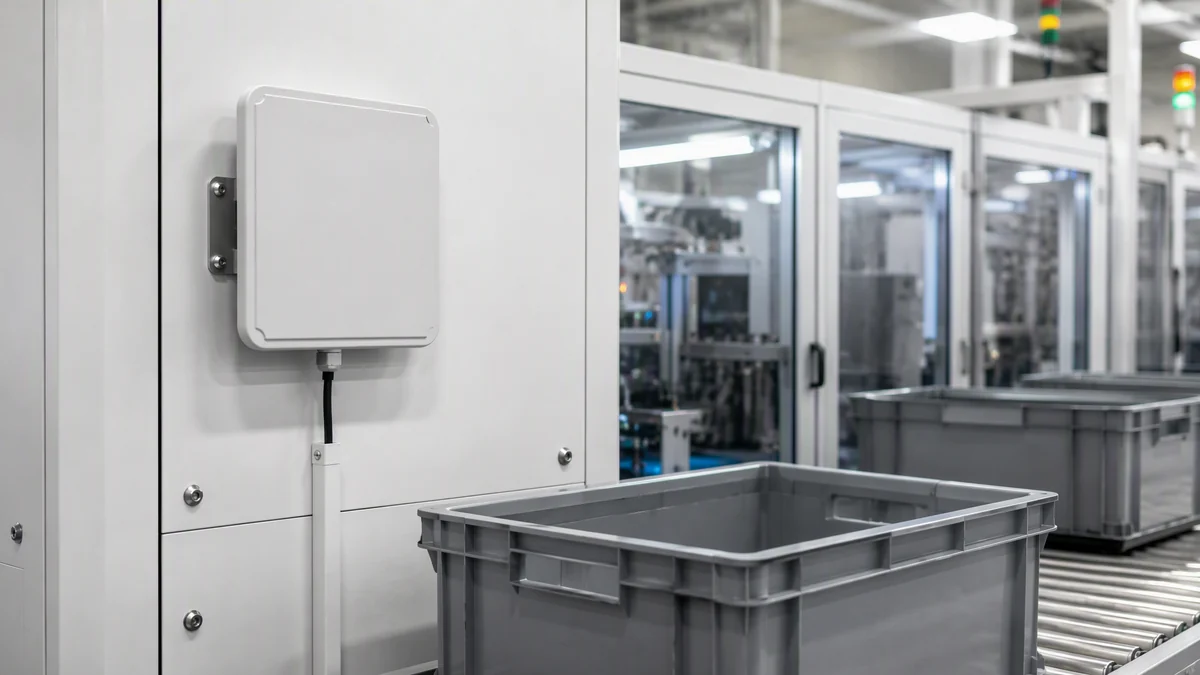
Identify tagged material carriers, tools, parts or assets at fixed production transfer points and return the result to the connected control workflow.
- Sensor- or PLC-triggered reading
- Host-side process verification
- Relay output for local response
The RLI-9dBi is intended for controlled, directional long-range checkpoints. For tighter workstations or shorter read zones, evaluate a lower-gain model; for the widest or longest-range requirements, compare the 12 dBi model. Final selection must be validated with the actual tag, lane width, speed and installation environment.
Read Performance
Up to 15 m UHF RFID Reading Under Project Conditions
The product data sheet states a typical continuous read range of 0–15 m. This is not a guaranteed working distance for every RFID tag, vehicle, container, asset or installation.
The antenna and reader operate as one integrated RF system for directional long-range identification.
Output power is configurable and must remain within the permitted regional operating requirements.
Confirm tag sensitivity, mounting material, approach speed, reader angle, lane geometry and surrounding RF conditions.
Actual performance varies with tag antenna size and sensitivity, mounting material, tag orientation, reader angle, object movement, nearby metal or liquid, multipath reflection and RF interference.
Communication and I/O
Connect the Long-Range RFID Read Point to the Control System
Specify the host interface, external trigger source, output action and DC power arrangement before ordering the final RLI-9dBi configuration.
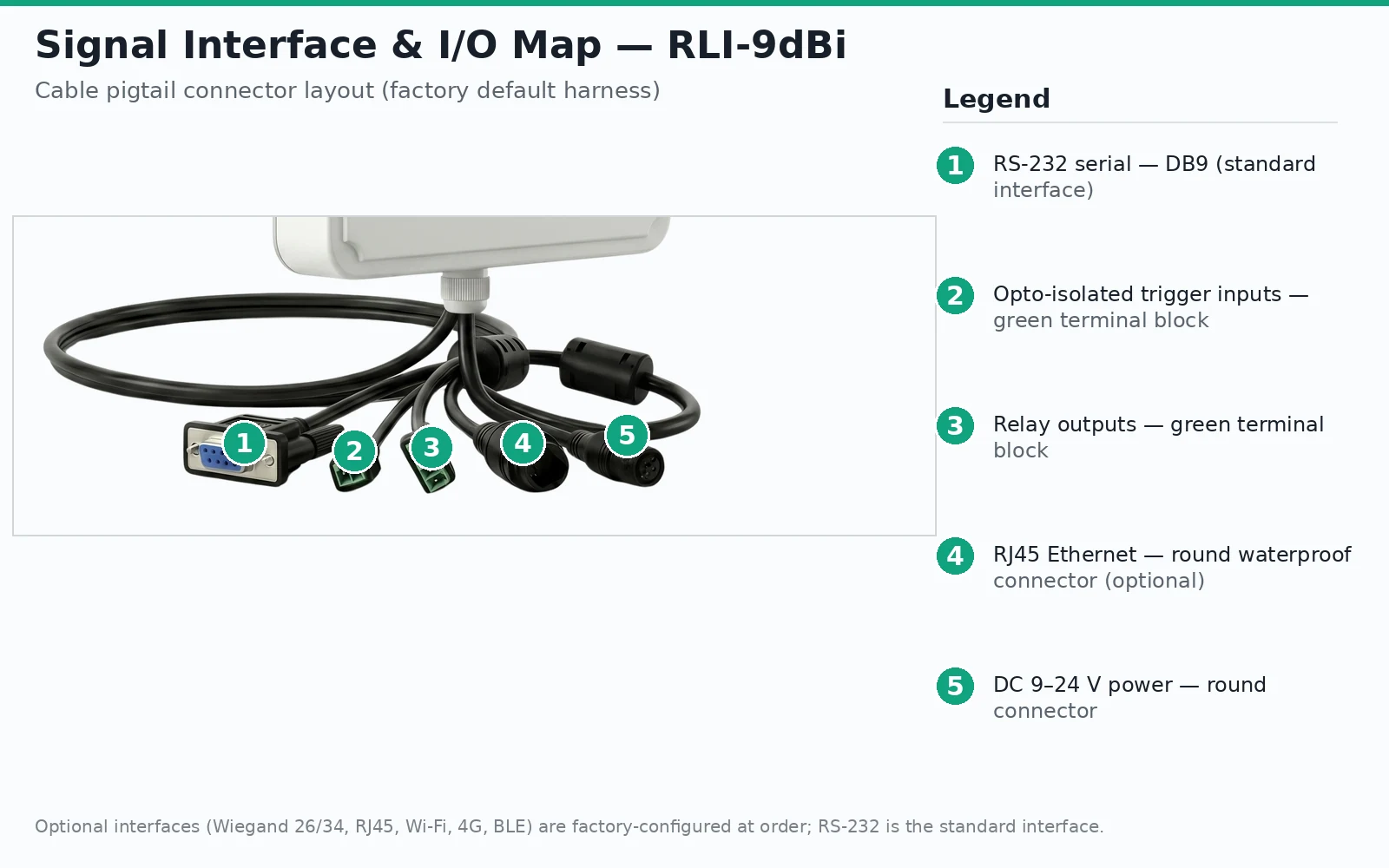
- 1RS-232 Serial Communication
Selectable baud rates: 9600, 19200, 115200 by default, and 460800 bps.
- 2Two Opto-Isolated Inputs
Receive trigger or control signals from compatible sensors, PLCs or external devices.
- 3Two Relay Outputs
Return identification or validation results to compatible indicators, alarms, gates or control circuits.
- 4DC 9–24 V Power
Use the dedicated DC input and confirm the supplied connector and cable arrangement for the project.
- 5Optional Communication Configuration
Selected configurations may include Wiegand 26/34, RJ45 Ethernet, Wi-Fi, 4G or BLE. Confirm which interfaces are required when ordering.
Configuration-dependent interfaces: Optional wired and wireless interfaces are not necessarily present together on every unit. Confirm the required communication and cable combination before ordering.
Project Configuration
Configure the RLI-9dBi for the Actual Lane or Checkpoint
Frequency, tag performance, communication, power and lane conditions should be confirmed as one project configuration rather than selected as isolated specifications.
Technical Specifications
RLI-9dBi Specifications and Configuration Details
Confirm the regional frequency, optional communication interfaces, cable definitions and supplied accessories before production ordering.
| RF Performance | |
|---|---|
| Product type | Integrated UHF RFID reader |
| Air-interface protocol | ISO 18000-6C / EPC Class 1 Gen 2; supports GB/T 29768 and GJB 7377.1 |
| Frequency configuration | 840–960 MHz hardware range; configured for the required regional operating band |
| Frequency mode | FHSS or fixed frequency, software configurable |
| RF output power | Up to 33 dBm ±1 dB |
| Receiver sensitivity | -78 dBm maximum receiver sensitivity |
| Continuous read range | 0–15 m typical, subject to tag and site conditions |
| Continuous write range | 0–6 m typical, subject to tag and site conditions |
| Read rate | Up to 400 reads per second |
| Multi-tag handling | 600 tags in 3 seconds, adjustable according to the data sheet |
| Integrated Antenna | |
| Antenna gain | 9 dBi |
| Polarization | Circular polarization |
| Communication and I/O | |
| Standard communication | RS-232 |
| Optional communication | Wiegand 26/34, RJ45 Ethernet, Wi-Fi, 4G or BLE by selected configuration |
| RS-232 baud rate | 9600 / 19200 / 115200 default / 460800 bps |
| Ethernet speed | 10M / 100M adaptive on Ethernet configurations |
| Digital inputs | 2 opto-isolated inputs |
| Control outputs | 2 relay outputs; DC 30 V / 1 A or AC 125 V / 0.75 A |
| Status indication | LED indicator and buzzer |
| Power, Mechanical and Development | |
| Power input | DC 9–24 V |
| Dimensions | 258 × 258 × 83.2 mm |
| Housing material | ABS + aluminum backplate |
| Weight | 1.45 kg |
| Development support | API development kit; C# and Java support |
| Standard accessories | Power adapter, mounting bracket, Ethernet cable and test card |
| Optional accessories | Universal wall-mount bracket and pole-mount bracket |
Published range and multi-tag figures are reference specifications. Validate the actual tag population, object material, lane geometry, reader placement, interface configuration and RF environment before deployment.
Design-In Views
Mechanical Drawing and Product Views
Use the drawing and connector views to review mounting space, cable routing and service access before final installation.
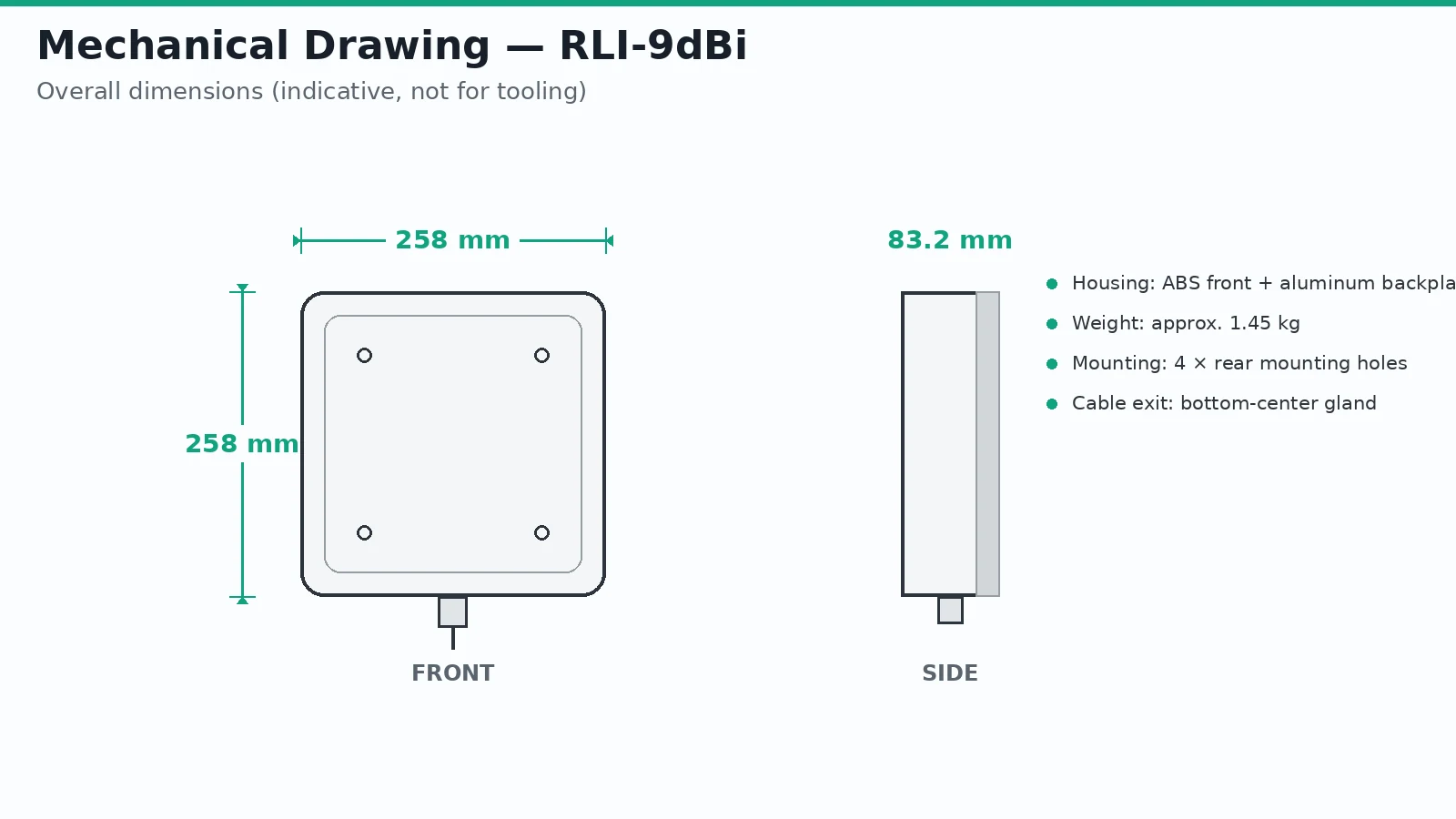
Mechanical Drawing
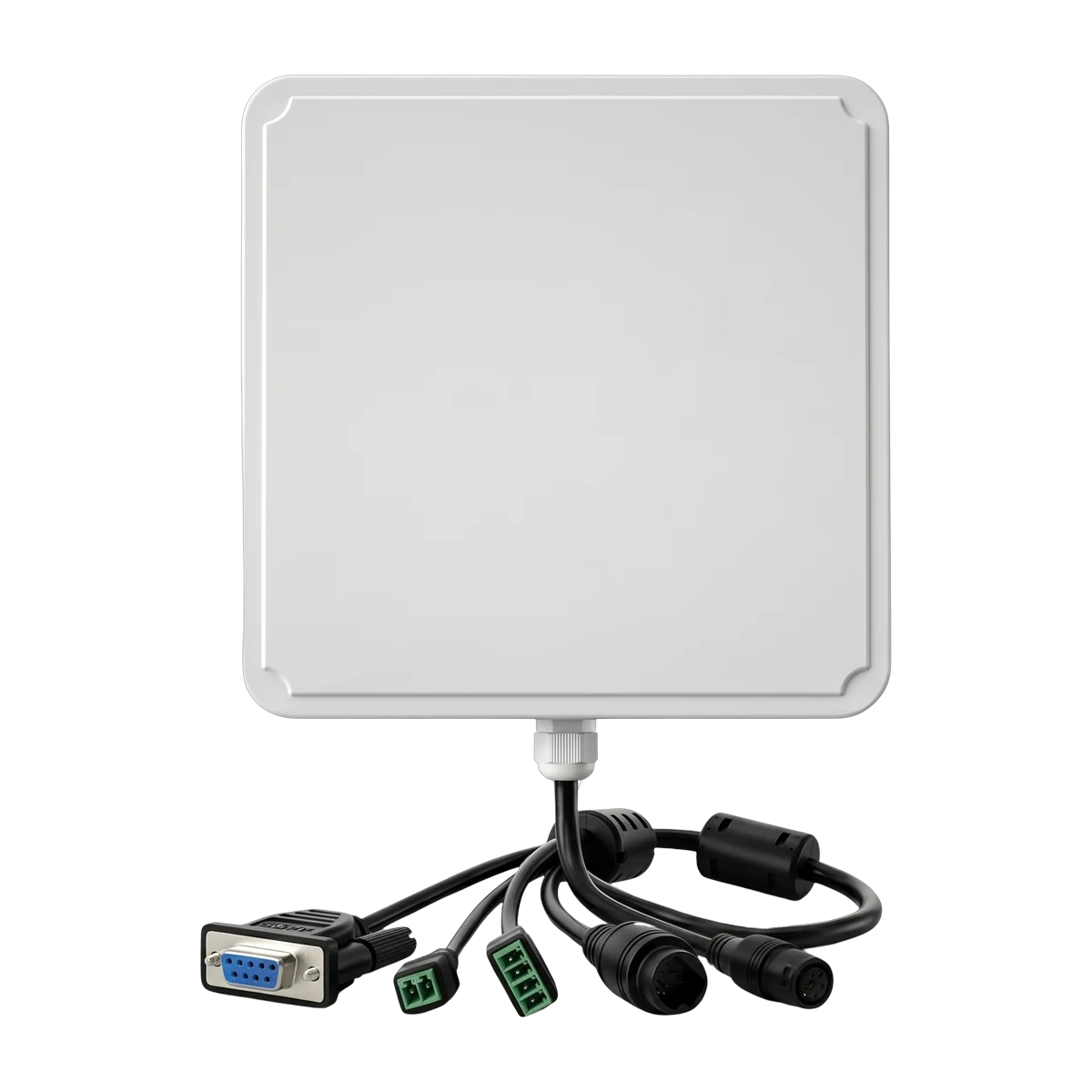
Front View
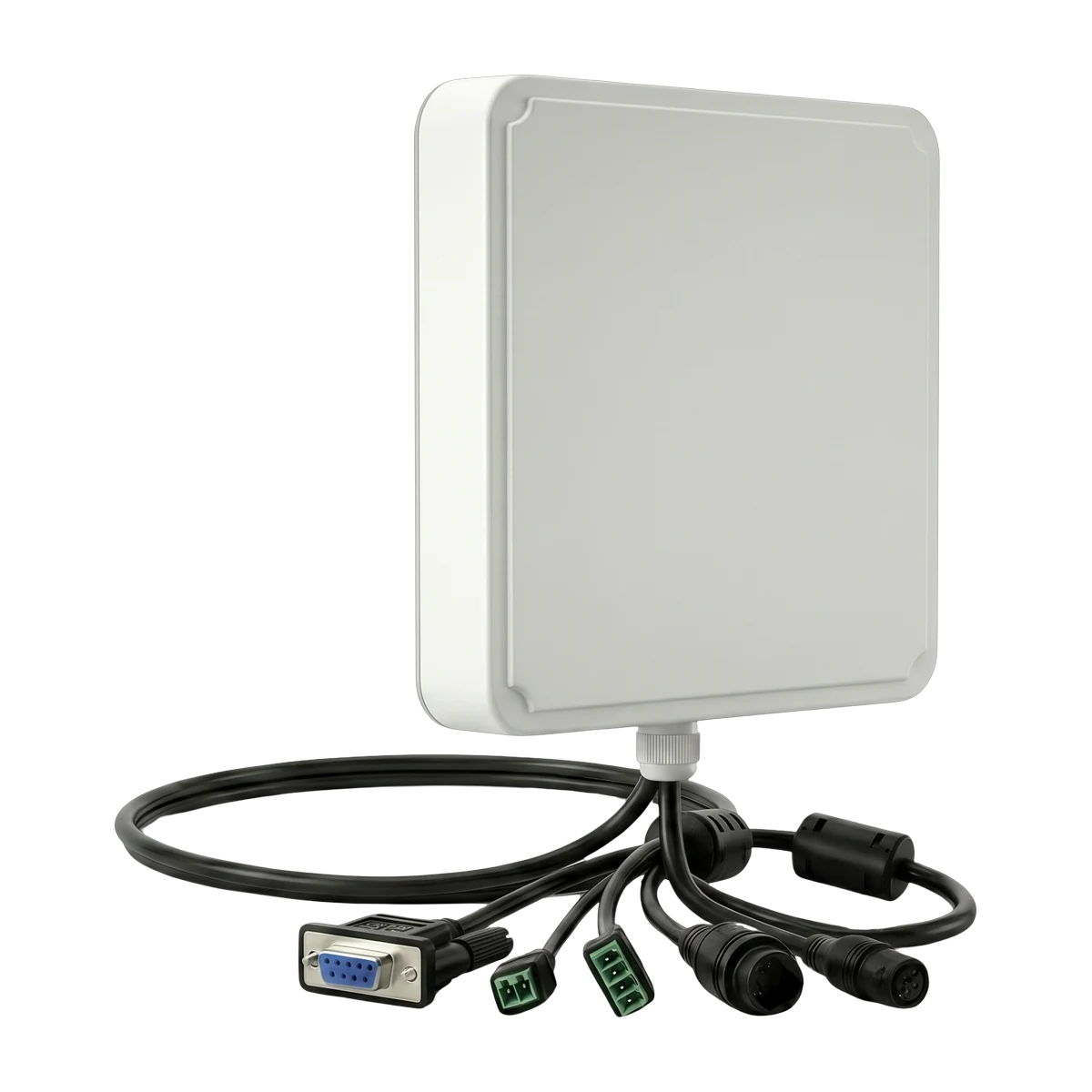
Side and Cable View
Technical Resources
Resources for Evaluation and Integration
Request the files required to evaluate the RLI-9dBi, develop the host connection and review the mechanical installation.
Product Data Sheet
Review RF, antenna, communication, I/O, environmental and mechanical specifications.
Request Data SheetSDK and Demo Software
Start serial integration, reader configuration and secondary development with the available software resources.
Request SDKI/O and Mechanical Files
Confirm signal definitions, connector requirements, dimensions and the intended mounting arrangement.
Request Engineering FilesFAQ
RLI-9dBi Integrated UHF RFID Reader FAQ
What is integrated inside the RLI-9dBi?
The device combines a UHF RFID reader engine and a built-in 9 dBi circularly polarized antenna in one fixed unit, together with communication, opto-isolated input and relay-output connections.
Can the RLI-9dBi always read RFID tags from 15 meters?
No. The data sheet states a typical continuous read range of 0–15 m. Actual distance depends on tag design, mounting material, orientation, lane geometry, reader placement, output power, regional settings and the RF environment.
Which regional frequency versions are available?
The reader has an 840–960 MHz hardware range and should be configured for the permitted operating band in the destination country or region.
Which RS-232 baud rates are supported?
The selectable baud rates are 9600, 19200, 115200 by default and 460800 bps.
Which communication options are available?
RS-232 is listed as the standard interface. Wiegand 26/34, RJ45 Ethernet, Wi-Fi, 4G and BLE are optional and depend on the selected configuration.
How can the two inputs and two relay outputs be used?
The opto-isolated inputs can receive external trigger signals. The relay outputs can return a result to compatible indicators, alarms, gates or control circuits defined by the system integration.
What do the 400 reads per second and 600 tags in 3 seconds figures mean?
They are reference performance figures stated in the data sheet. Actual multi-tag performance depends on tag population, orientation, movement, RF settings, collision conditions and the installation environment.
Is the RLI-9dBi a complete RFID software solution?
No. It is integration-ready RFID hardware. Application logic, database processing, event filtering and workflow decisions are implemented by the connected host or customer software.
When should a different RLI antenna-gain model be considered?
Consider a lower-gain model for tighter workstations or shorter read zones, and compare the 12 dBi model for the widest or longest-range requirements. Final selection should be based on the actual tag, lane and site test.
Project Configuration
Configure the RLI-9dBi for Your Long-Range RFID Checkpoint
Send the deployment region, tag model, vehicle, container or object type, lane width, required distance, communication interface, trigger source and intended relay response for technical review.